Showing posts with label Vocational training. Show all posts

9 May 2013

Virtual learning is here already

After three days in Northern Ireland to visit South West College, one of the conclusions is that blended learning works very well. Never mind the elegant ways ILT is integrated into their classrooms, in 2012 they held their Virtual Week which was the real eye opener.

The idea was to tutor for five days without any student coming in to class. I wouldn't say that this is the only way to promote blended learning, but it shows to teachers and students alike that any course lends itself to the blended approach.

Teachers in vocational teaching and training often say that electronically enhanced learning cannot be achieved in their field. The SWC example shows just how easily it can be done. In most cases, it will support the learning but it's possible to hold distance learning classes in VET. The thing is, it will demand some extra preparation work of teachers and students alike. this demands a specific motivation.

The most important lesson I take away from this experiment is that if there are enough determined staff, an experience such as this is very rewarding and can be highly succesful. You don't have to wait for heavy snow and disrupted transport systems to find an incentive to use blended learning in vocational training.

And as most people have already experienced, we're seeing ever more severe climate effects from snow to flooding and in Western Europe, we're just not used to the consequences. Yet.

3 Dec 2008

The tools are in. Are teachers?

In adult education, online tools are a great benefit to the teaching process. They provide many new possibilities. These have in common that they detach the physical presence from the continuing learning experience.

Unlike daytime education, many continuing learners have their classes in the evening. This makes for a difficult marriage of spare time - or daily chores - and class attendance.

When we started a project to engage more women in evening courses in informatics, one of the ideas was to start the course after 8 p.m., since women then had the opportunity to put the children to bed.

Some might think this as anti-feminist, but most women in the committee agreed it was a good idea. The reality is, after all, that women spend much more time working for the household. To take this into account is a good strategy to gain women's attendance to traditionally more difficult subjects, such as informatics.

Of course, many men also have difficulties coping with modern agenda management, so the idea was to allow everybody to start later, not just the women. Training analyst-programmers in continuing education is a challenge to anyone.

Why didn't we go through with the project?

First of all, there was a lot of resistance from teachers. The thing is, we wanted to start classes later and end sooner. But the time not spent in class would be spent online. We'd set up a platform with assignments and a forum so that the classes would only take place every two weeks. When there wasn't a physical class, an online exercise session would take place. The week of the class, an assignment as a follow-up to the online exercises would be posted, the result then submitted to be discussed in class.

This way, the course takers gained time for their assignments - which are traditionally done solitary or in pairs in class - since they could work from home. The forum would allow interaction with teachers and other students and the physical classes could remedy any deficiencies in knowledge, as well as provide the knowledge transfer. This last aspect is quite limited for analyst-programmers, since most is learnt by practising.

It is still a model I fully support. We couldn't get the necessary backing for the experiment, but I hope it will happen in the future, for there is much to be gained from such a blended approach.

29 Oct 2007

Learning leads to... more learning


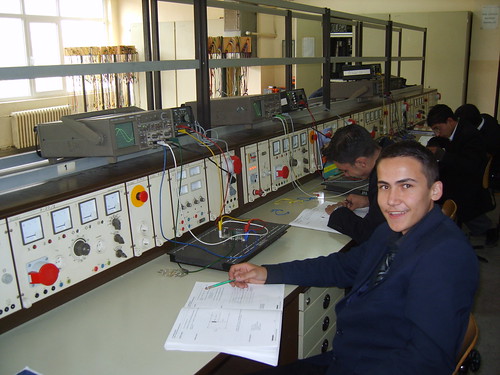
I've been in Turkey on an extremely intensive five day study visit of Ankara Vocational Education and Training projects and institutions. It was enlightening to spend some time in the field among the young and not so young that are the object of many learning initiatives.

Especially since in Turkey there's so much investment of new education products going on, I had the opportunity to see the many stages of education development. During the different insights I gathered in numerous meetings, one was this: it takes a lot of learning to enhance the learning experience. And it usually starts with languages.

Perhaps in the past learning could be straightforward. There would be some subject you could be taught about in a certain time frame.

No longer is this the case. Acquiring knowledge is a much more incremental process, where the process is often part of the objective. So when I want to learn about a political structure of a country, I can do this by reading books about that country. This is learning old style.

I can also visit Wiki pages in the country's language(s), and count on the fact that some of the key concepts will be in a language I can comprehend. Which they will often be. I can try translating certain parts through one of the excellent translation sites. But all this means that I will first have to learn the language of Wiki, the way it works, the value of the contribution system.

In this case, my seeking of knowledge will make me acquire other knowledge first.

In the same vein, as a teacher teaching about the political structure of a country will it no longer be the teacher's job to write or provide books about the subject, but to teach how to access the available sources. The way Wiki works, the value of blogs or the relativity of them, the journalistic principles.

And of course how a library works, but perhaps this will also be available in accessible form so a teacher won't have to make it up all over again.

It's the teacher as coach idea, but it is of course broader than that. It's also the value of teaching respect for other ways, other languages, and an insight in the particularities of learning another than one's own language.

The net is multi-language and instead of being a drawback, this can be an aid to understanding.

When I was in China, it was obvious many Chinese are pragmatic about this; they use English when speaking to foreigners. Of course they are well aware of the fact that Chinese will get them very far in a large part of their world, but they know that by learning the lingua franca, more information and opportunities become available.

It is a message I can't stress enough: languages are a good way to speed up learning. If I want to learn something about the latest technology, do I have to confine myself to my own language to look for sources? Or can I use more to get to understanding faster? If I want to ask a question to an engineer, will it not help if I understood her or his language?

There is so much language learning material readily available, it would be short-sighted not to use it. I've been learning Portuguese both formally and online and in the twelve years since I started being interested in it, so much has become available. And this for the fifth language in the world. Just imagine what you could find in English!

Links:
http://languagecenter.cla.umn.edu/lc/Citlali/Portugues.html
http://www.graudez.com.br/portugues/exerc.htm
or
http://www.google.be/search?hl=nl&as_qdr=all&q=exercicios+de+portugues&meta=